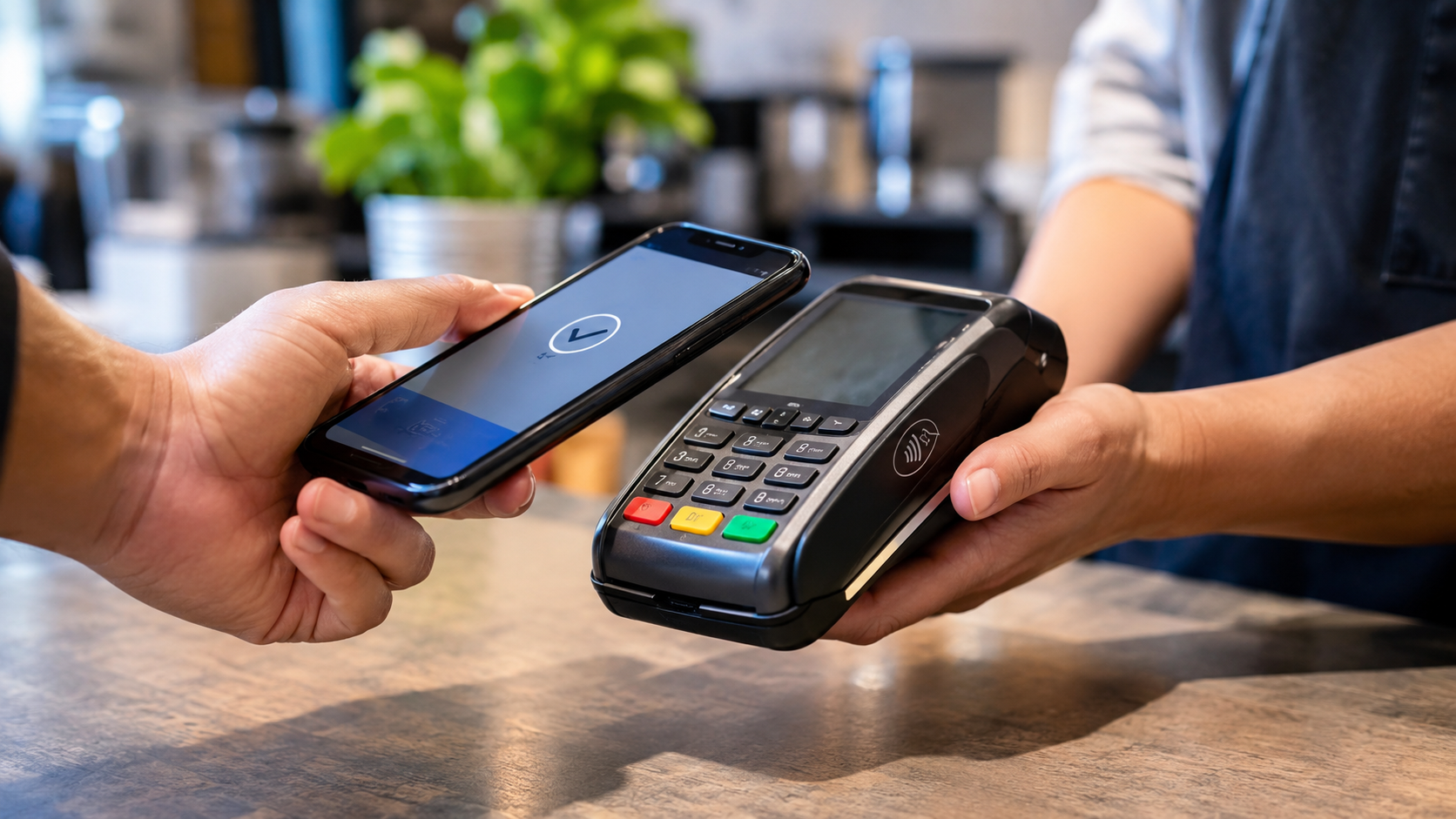
If you walk into a local boutique in New York or a bustling artisan coffee shop in London today, you will likely notice a massive shift at the checkout counter: the traditional, clunky plastic card terminal is rapidly disappearing.
A shop owner no longer needs to buy a card reader just to accept a contactless payment. With SoftPOS, a customer can tap a bank card against a compatible iPhone or Android device, and the transaction goes through much like it would on a conventional payment terminal.
That sounds like a straightforward improvement. Payment companies such as Square and other fintech providers have made smartphone-based payment acceptance increasingly accessible, giving small businesses another way to handle card transactions without investing in dedicated equipment.
But replacing an EDC machine with a smartphone involves more than removing a piece of hardware from the checkout counter.
The processing rate may be less competitive than expected. A phone used for payments needs proper security controls, reliable connectivity, and careful management. There is also the customer experience to consider, particularly when someone is asked to enter a PIN on a device that looks like an ordinary mobile phone.
For a street vendor, these trade-offs may be perfectly acceptable. For a retailer processing hundreds of payments every day, they deserve closer attention. The question is not simply whether SoftPOS works. It is whether switching to it makes financial and operational sense.
What Is SoftPOS (Tap-to-Pay) vs. Traditional EDC Hardware?
SoftPOS, short for Software Point of Sale, turns a compatible smartphone or tablet into a contactless payment acceptance device. It uses the phone’s built-in Near Field Communication (NFC) technology to communicate with contactless bank cards and mobile wallets.
The process is familiar to anyone who has used contactless payments. A customer holds a card or a compatible device near the merchant’s phone. The payment application captures the transaction securely and sends it to the payment processor for authorization.
There is no separate contactless reader to carry, connect, or charge.
Services such as Apple Pay and Google Wallet can also be used for customer payments, provided the merchant’s SoftPOS application supports the relevant payment methods. The underlying NFC technology is explained in MoneyHelper’s guide to contactless payments.
A traditional EDC terminal takes a different approach. Rather than relying on a general-purpose smartphone, it uses hardware built specifically for payment acceptance. Depending on the model, a terminal may include a contactless reader, EMV chip slot, magnetic-stripe reader, and physical PIN keypad.
Companies such as Verifone and Ingenico manufacture dedicated payment terminals. More advanced systems from providers such as Clover and Toast combine payment acceptance with business tools, including sales reporting, inventory management, and restaurant operations.
This distinction matters. A payment terminal is often part of a larger checkout system, not merely a device for reading cards.
Why Is SoftPOS Gaining Attention?
The shift toward contactless payments has given SoftPOS a natural opening. In several Western European markets, tapping a card has become an ordinary part of shopping. Merchants already accustomed to contactless transactions may find it relatively easy to introduce smartphone-based acceptance.
The United States has its own adoption pattern. Contactless payments have become more common, but merchant requirements vary widely. A small independent business may need little more than a phone and a payment account, while a larger retailer may require integrated registers, employee controls, and detailed transaction reporting.
SoftPOS appeals most strongly to merchants who want to start accepting cards without purchasing another device. Delivery workers, market traders, mobile service providers, and pop-up retailers are obvious examples.
The attraction is understandable. Yet the low barrier to entry does not tell the whole financial story.
The Financial Trap: Flat-Rate vs. Interchange-Plus Fees
The first thing many merchants notice about SoftPOS is the absence of a separate card reader. There is no need to spend several hundred dollars on dedicated hardware if an existing smartphone can do the job.
That saving is real, but it is only one part of the payment bill. Processing fees continue every time a customer pays, and those recurring charges can become more important than the original equipment cost.
The Myth of Free Payment Acceptance
Many smartphone payment services use flat-rate pricing. The provider charges a fixed percentage of the transaction value, sometimes with an additional fee for each payment.
Square, for example, publishes an in-person rate of 2.6% plus $0.15 per transaction for its US Free plan. Merchants can check the current structure in Square’s official processing fee guide.
The appeal is simplicity. A business owner does not have to work through separate interchange charges and processor markups to understand the basic fee.
The downside becomes more apparent as sales grow. A rate that seems manageable for a business processing a few thousand dollars each month can consume a substantial amount of revenue when monthly card turnover reaches tens of thousands of dollars.
This is why established merchants often compare flat-rate pricing with interchange-plus agreements.
Why Interchange-Plus Can Be More Competitive
With interchange-plus pricing, the merchant pays the underlying interchange and card-network costs, together with an agreed markup from the payment processor.
The final rate is not necessarily the same for every transaction. It can depend on the card type, payment method, network, and other factors. In return, the merchant gets a clearer breakdown of what the processor charges on top of the underlying costs.
Providers such as Helcim explain this structure in their interchange-plus pricing information.
For a business with consistent card volume, this model may offer better value than a bundled flat rate. It also gives the owner more information when reviewing monthly processing statements.
There is an important point worth clearing up, though. A physical EDC terminal does not automatically come with interchange-plus pricing. The payment processor determines the available pricing model. Merchants can use dedicated terminals with flat-rate plans, just as some smartphone payment services may offer different pricing arrangements.
The comparison should therefore focus on the actual merchant agreement, not simply the device.
What Happens When a Business Processes $30,000 a Month?
Consider a retail shop that handles $30,000 in card payments every month. It completes around 600 transactions, with an average purchase of $50.
/
The following example compares two hypothetical pricing arrangements:
| Cost component | SoftPOS flat rate | EDC interchange-plus |
|---|---|---|
| Monthly card volume | $30,000 | $30,000 |
| Percentage fee | 2.6% | 2.2% |
| Per-transaction fee | $0.15 | $0.10 |
| Monthly percentage cost | $780 | $660 |
| Monthly transaction cost | $90 | $60 |
| Total monthly fees | $870 | $720 |
The difference is $150 every month, or $1,800 over a year.
That is enough to change the economics of the decision. A merchant who avoids buying a $300 terminal but pays an additional $1,800 in annual processing fees has not necessarily made a good deal.
These figures are illustrative, not a quotation from a payment provider. The assumed 2.2% effective interchange-plus rate will not apply to every merchant. Actual costs depend on card mix, transaction type, processor markup, and contract terms.
Still, the example highlights a point that is easy to overlook: the cheapest device does not always produce the cheapest payment operation.
Customer Trust and PIN Security: The Risks of Using Smartphones for Payment Authentication
A customer may be perfectly happy tapping a card against a smartphone. The situation can feel different when the payment process asks for more personal interaction.
Imagine a delivery driver handing over a phone and asking a customer to enter a card PIN on its touchscreen. Some people will accept this without a second thought. Others may hesitate, particularly if the device appears to be the driver’s personal smartphone.
That reaction is worth taking seriously. Payment technology has to work for the customer’s peace of mind, not just the merchant’s convenience.
The Regulatory Reality: PSD2, SCA, and PCI Compliance
Regulatory Compliance and Device Security: PSD2, SCA, and PCI Standards in SoftPOS vs. EDC
In the European Union and the UK, customer hesitation isn’t just a psychological hurdle; it is tied directly to strict regulatory frameworks.
Under the Second Payment Services Directive (PSD2), merchants must adhere to Strong Customer Authentication (SCA) mandates. These laws are designed to curb fraud by requiring multi-factor authentication for higher-value transactions.
When a transaction on a SoftPOS app triggers an SCA check or exceeds the regional contactless limit (such as €50 or £100), the app must force a Cardholder Verification Method (CVM)—usually requiring a physical PIN entry on the glass.
This introduces a massive compliance and security debate:
- Hardware vs. Software Isolation: Dedicated EDC hardware uses specialized, isolated PIN-entry components that are heavily certified under PCI-PTS (Payment Card Industry PIN Transaction Security) standards. If someone tampers with a Verifone or Clover terminal, the encryption keys securely erase themselves instantly.
- The Commercial Device Risk: A standard Android smartphone or iPhone running a SoftPOS application lacks this hardened hardware-level barrier. Because it is a general-purpose device connected to the internet, it is inherently more vulnerable to screen-scraping malware, root exploits, and hidden keyloggers.
If a merchant’s phone is compromised and customer PIN data is leaked, the business faces devastating non-compliance fines from the PCI Security Standards Council, alongside the loss of their merchant account.
For retail establishments handling high daily transaction volumes, the physical privacy shields and certified security architecture of a traditional EDC terminal remain a necessary shield against modern liability and chargebacks.
The Customer Psychology Behind PIN Entry
In the UK and many European markets, Chip and PIN has been part of everyday card payments for years. Customers are accustomed to inserting a card into a terminal and entering their PIN on a separate keypad.
A dedicated terminal makes the process familiar. The customer can see where the card goes and where the PIN is entered. The device has an obvious payment function.
SoftPOS changes that interaction. Some approved solutions support PIN entry directly on a smartphone screen, but the experience is different from using a conventional keypad. Customers may wonder whether the screen is secure or whether someone else can see what they enter.
This does not mean smartphone PIN entry is automatically unsafe. Properly certified SoftPOS solutions use security controls designed for payment acceptance. Nevertheless, merchants should consider how their customers will react before making the technology their only payment option.
A few seconds of hesitation at checkout may not seem significant. Repeated across hundreds of daily transactions, however, small interruptions can affect the customer experience.
Understanding CVM and Contactless Payment Limits
Cardholder Verification Method, or CVM, is the process used to verify that the person presenting a payment card is authorized to use it.
Depending on the transaction, verification may involve a PIN, signature, or authentication through a mobile device. The required method can vary according to the card issuer, payment network, transaction amount, and local rules.
This is also where merchants need to be careful with contactless limits. There is no single threshold that applies to every country and every type of payment.
In the UK, £100 has traditionally been the standard contactless limit for a single card transaction. However, the Financial Conduct Authority introduced greater flexibility from March 19, 2026, allowing banks and payment providers with appropriate fraud controls to set their own limits. The details are available in the FCA’s announcement on contactless payment limits.
Mobile wallet payments can work differently. Customers may authenticate through Face ID, a fingerprint, or a device passcode, allowing some transactions to exceed the standard physical-card contactless limit.
In the United States, there is no universal $50 contactless ceiling across all card issuers and networks. European rules also vary. France, for example, has traditionally applied a €50 limit to conventional contactless card payments, as described in its official public service guidance.
For a merchant, the practical question is whether the chosen SoftPOS provider supports the verification methods needed for the cards and transactions the business accepts. A solution that cannot handle a required verification step can turn a simple checkout into a failed sale.
Are Smartphones More Vulnerable to Payment Fraud?
A smartphone is a general-purpose computer. Employees use it to make calls, install applications, browse the internet, and access different networks. That flexibility makes it useful, but it also creates security responsibilities that a dedicated payment device may not share to the same extent.
Malicious applications, compromised operating systems, unauthorized modifications, and poor device management can all introduce risks. A rooted or jailbroken phone, for instance, may fail the integrity checks required by a payment application.
These security concerns reflect a wider challenge facing the financial industry as digital financial services continue to expand. Financial institutions must increasingly address cybersecurity, fraud prevention, and technology-related risks, as explored in our article on digital financial services and cybersecurity.
That does not make SoftPOS inherently insecure. The technology has its own security framework.
The PCI Security Standards Council’s Mobile Payments on COTS (MPoC) standard establishes security requirements for payment acceptance on commercial smartphones and tablets. It covers solutions that accept contactless payments and, where supported, PIN entry.
A properly implemented solution can incorporate encryption, device integrity checks, monitoring, and other safeguards. Merchants should also check whether their provider’s solution appears on the official PCI MPoC solutions listing.
Dedicated terminals have their own security requirements. Relevant devices may be assessed against PCI PIN Transaction Security (PTS) standards, which address protections for payment PIN entry and related hardware.
Neither approach removes the need for responsible management. A merchant still needs to control employee access, install required updates, protect devices, and follow the payment provider’s security instructions.
The difference is in the type of equipment and the controls surrounding it. A smartphone-based system requires particular attention to the wider device environment, while a dedicated terminal is built around a narrower payment function.
The Operational Nightmare: Real-World Friction Points
The financial and security questions are important, but merchants also have to consider what happens during an ordinary working day.
A payment system may perform perfectly during a demonstration. Its weaknesses often become visible when a queue forms, a connection drops, or an employee needs to process a transaction quickly.
The Incoming Call Problem
Picture a coffee shop in London during the morning rush. Customers are waiting, orders are coming in, and the cashier is using a smartphone to accept contactless payments.
A personal call or notification may interrupt the payment application, cover part of the screen, or distract the employee. The application may recover without difficulty, but the transaction can still take longer than expected.
A dedicated EDC terminal avoids much of this distraction because employees do not normally use it for calls, messages, or social media.
Of course, a business can assign a smartphone exclusively to payment acceptance. That solves some of the problem, but it also means the phone is no longer a free substitute for a card reader. The business must purchase, maintain, and secure another device.
Battery Degradation and Hardware Replacement
A phone used throughout a working day may spend hours with its screen active, wireless connection running, and payment application ready for transactions.
That creates a different pattern of use from an employee’s personal phone, which may sit idle for much of the day. Frequent charging and sustained use can contribute to battery wear over time.
Consider a business that buys an $800 smartphone for payment acceptance. If it replaces the device after 18 months, the annualized hardware cost is approximately $533.
This is a hypothetical ownership calculation, not a prediction that every phone will need replacing after 18 months. Battery replacement or a longer service life could reduce the cost.
A dedicated payment terminal also has a finite lifespan and may require repairs, software support, or replacement. The sensible comparison is the total cost of operating both systems, including spare equipment and maintenance.
For a merchant using an existing phone, SoftPOS may still be cheaper. But a business that buys new smartphones for several employees should include those costs in its budget.
The Offline Mode Problem
Connectivity can become a serious weakness when a payment application depends on a live internet connection.
Imagine a food truck operating at an outdoor event. The mobile network becomes congested just as customers begin arriving. The merchant has products ready to sell, but the phone cannot reach the payment processor.
Some SoftPOS applications may be unable to authorize transactions until the connection returns. The result can be a queue of customers who want to pay by card but cannot complete their purchases.
Certain traditional terminals and smart POS systems offer offline processing or store-and-forward capabilities. These features can temporarily store eligible transactions and submit them when connectivity is restored.
There are limitations. Offline transactions may be declined later, and the merchant can be left responsible for the loss. Availability depends on the terminal, payment processor, card scheme, and merchant agreement.
Nor should merchants assume that every physical EDC machine works offline. The feature needs to be explicitly supported and configured.
Some integrated POS platforms also provide additional connectivity options. Toast’s restaurant POS platform, for example, offers tools designed to support restaurant operations and connectivity needs.
Before choosing either technology, merchants should ask the provider a direct question: What happens to card payments when the internet connection disappears?
The answer may be more important than the advertised hardware price.
Direct Comparison: When to Keep Your EDC Machine vs. When to Go SoftPOS
SoftPOS and dedicated EDC terminals can both accept contactless payments, but their strengths become apparent in different business settings.
A mobile merchant may value the ability to carry one device in a pocket. A busy restaurant may need a payment system that works alongside table management, order processing, and staff accounts.
The following comparison highlights the practical differences.
| Comparison | SoftPOS | Physical EDC Terminal |
|---|---|---|
| Initial hardware cost | Usually lower | Higher upfront cost or rental |
| Payment processing fees | Often flat-rate | Flat-rate or interchange-plus |
| Portability | Excellent | Depends on terminal type |
| Contactless payments | Supported on compatible devices | Supported on compatible terminals |
| Chip and PIN | Depends on solution | Widely supported |
| Security controls | Software and device-based | Dedicated payment hardware |
| Battery management | Shares smartphone battery | Dedicated power or battery |
| Personal notifications | Potential interruption | Generally not applicable |
| Offline processing | Often limited or unavailable | Available on selected systems |
| Business integration | Depends on application | Often broader POS integration |
| High-volume operations | Depends on device and workflow | Often better suited to established operations |
When SoftPOS Makes More Sense
For a self-employed contractor who visits customers at home, carrying a separate card reader may be unnecessary. The same is true for a market trader who only processes a modest number of payments each day.
A compatible smartphone can handle contactless transactions without adding another piece of equipment to the merchant’s bag. The lower initial investment is particularly useful for businesses that are just starting out.
SoftPOS can also work well as a backup payment option. A retailer with conventional EDC terminals might use a smartphone-based solution during busy periods or when an additional checkout point is needed.
<
In these situations, flexibility is the main advantage. The merchant does not need a full payment setup at every location.
When Dedicated EDC Hardware Is the Better Investment
The calculation changes when a business depends on card payments throughout the day.
A supermarket, established retail shop, or busy restaurant may process hundreds of transactions across multiple employees. Such businesses often need equipment that remains dedicated to payment acceptance and integrates with the rest of their operations.
Restaurants have additional requirements. Payments may need to connect with table assignments, split bills, kitchen orders, and staff accounts. A standalone smartphone application may not provide the same level of integration as a complete POS system.
Platforms such as Toast’s restaurant POS system illustrate how payment terminals can form part of a broader operational setup.
High-volume merchants should also pay attention to processing agreements. Negotiating an appropriate pricing structure may have a greater long-term financial impact than saving money on the initial terminal purchase.
For these businesses, a dedicated EDC machine is not simply an older alternative to SoftPOS. It may be a more suitable tool for the way they operate.
Conclusion: SoftPOS Is Not Always the Cheaper Replacement for EDC
SoftPOS has made it easier for small businesses to accept card payments. A merchant can start with a compatible smartphone instead of purchasing a separate terminal, and that is a genuine advantage.
But the savings are not guaranteed to last. Processing fees can eat into margins as transaction volume increases. Employees need properly managed devices, customers must feel comfortable with the payment process, and the business needs a reliable way to handle connectivity problems.
For a delivery driver or independent market trader, those compromises may be reasonable. For a retailer processing hundreds of payments every day, they may create unnecessary costs and operational friction.
There is also no reason to treat the decision as an all-or-nothing choice. Some businesses may find that a combination works best: physical EDC terminals for regular checkout operations and SoftPOS for mobile payments, temporary sales points, or additional capacity.
Before replacing existing equipment, take a close look at the last 12 months of merchant statements. Compare the effective processing rate, per-transaction charges, hardware expenses, maintenance costs, and any additional service fees. Ask providers to explain their pricing in writing rather than relying on headline rates.
A payment system should fit the way a business actually operates. Saving money on a card reader means little if the new arrangement increases transaction costs or makes it harder for customers to pay.
The better investment is not necessarily the payment device with the lowest purchase price. It is the system that keeps transactions secure, checkout operations reliable, and processing costs under control.

Sofyanto adalah peneliti independen yang aktif menulis sebagai penulis lepas. Ia secara rutin mengulas topik keuangan pribadi, ekonomi dan bisnis, pertanian, pendidikan, kesehatan, teknologi serta hukum dari sudut pandang praktis dan observasional.